


Quick Summary
- What this article covers: A comprehensive reference for reading candlestick patterns, from basic anatomy to complex multi-candle sequences and volume confirmation.
- Why it matters: Every candle is a compressed summary of the battle between buyers and sellers during a specific time window. Learning to read this native language of the market is a non-negotiable skill for traders.
- Key insight: Candlesticks are a language, not a standalone trading strategy. Context and volume matter exponentially more than a single candle's shape.
- Who this is for: Active traders, technical analysts, and investors looking to sharpen their price action reading skills.
Introduction
Candlesticks are the trader's native language. Originating in 18th-century Japan to track rice futures, their names and structures are intentionally designed to communicate raw market sentiment.
When you look at a candlestick chart, you are not just looking at a line graph of prices. You are looking at a localized battlefield. The shape of every single candle tells you exactly who won, who lost, and whether the outcome of that period was decisive or heavily contested.
To trade effectively, you must stop looking at patterns as rigid rules and start interpreting the story they tell.
Core Concepts: The Anatomy of a Candle
Before memorizing complex patterns, you must understand the four foundational data points encoded into every single candlestick.
Candle = {O, H, L, C}
- O (Open): The starting price of the period.
- H (High): The highest price touched during the period.
- L (Low): The lowest price touched during the period.
- C (Close): The final price at the end of the period.
Visualizing the Structure:
The thick rectangular section of the candle is known as the body, which connects the Open (O) and Close (C). The thin lines extending above and below the body are called wicks (or shadows), representing the High (H) and Low (L).
- Green (Hollow) Body: Close > Open. This indicates a bullish period where buyers drove the price up.
- Red (Filled) Body: Close < Open. This indicates a bearish period where sellers forced the price down.
Deep Dive: The Pattern Library
Market momentum shifts through distinct phases. The shapes of the candles during these phases act as real-time gauges of buying and selling pressure.
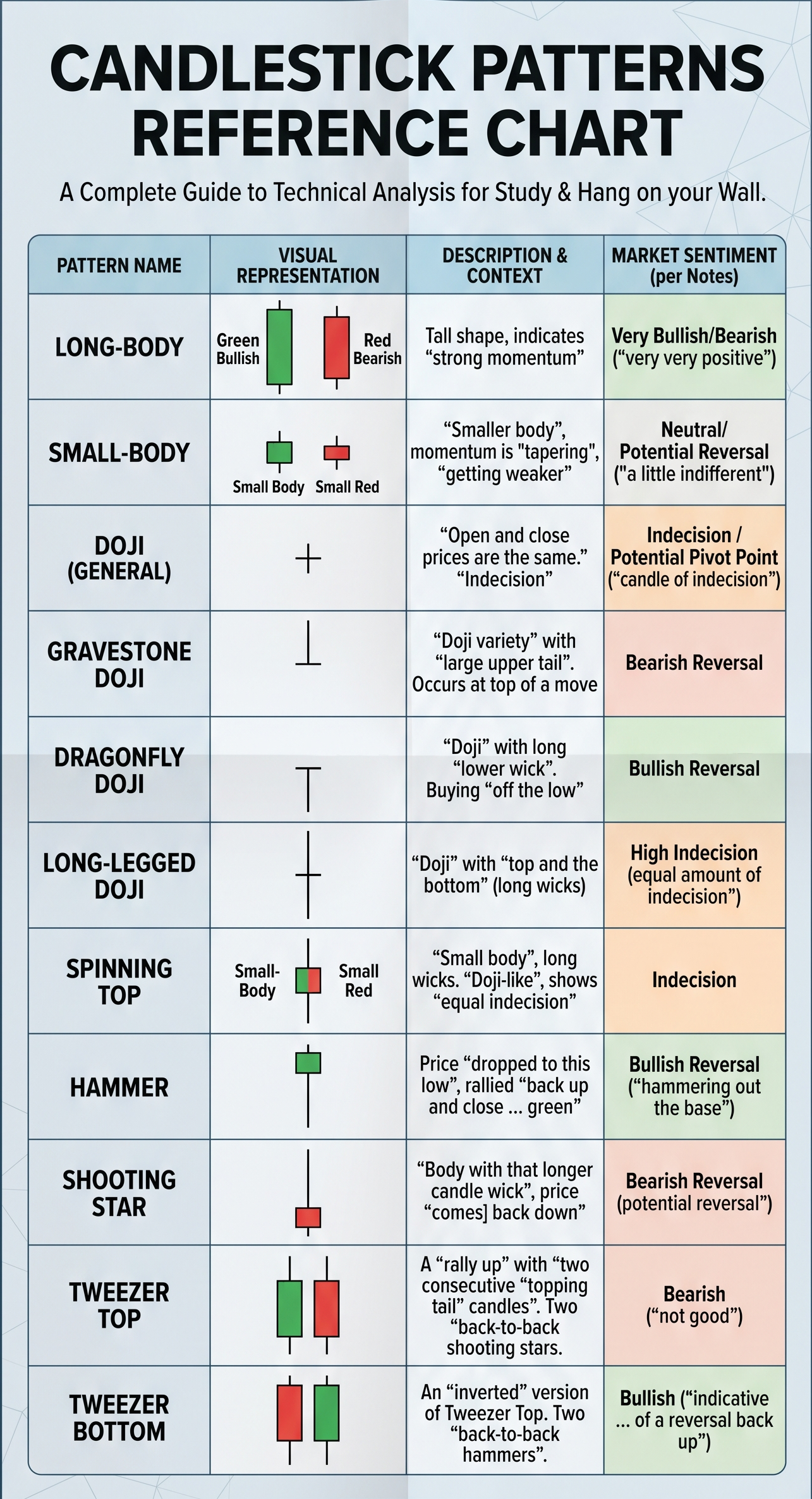
1. Long-Body Candles: Strong Momentum
Tall candles with minimal wicks indicate high conviction.
| Pattern Type | Visual Characteristics | Market Sentiment |
|---|---|---|
| Long Green | Tall green body, minimal wicks | Very Bullish — Buyers in control |
Trading Implication: Consecutive long-body green candles mean momentum is accelerating. This environment is where a trader's edge lives. Conversely, when the bodies start shrinking, it is your first hint that the directional move is cooling off.
2. Small-Body Candles: Fading Momentum
Small bodies with small wicks represent hesitation. Buyers and sellers are roughly matched, resulting in tapering momentum.
Warning Signal: When a sequence of large green candles gives way to small bodies, momentum is tapering, often preceding a reversal. If you are holding a long position, seeing small bodies is your cue to tighten stop-losses.
3. The Doji Family: Indecision and Pivots
A doji occurs when the opening and closing prices are the same (or practically identical), forming a thin horizontal line instead of a body. It is the ultimate candle of indecision.
| Column A | Column B | Column C |
|---|---|---|
| Example | Example | Example |
| Example | Example | Example |
(Note: Similar to a doji, a Spinning Top features a small body with noticeable wicks on both sides, indicating mild indecision where the period ended near where it started despite intraperiod volatility.)
4. High-Probability Reversal Archetypes
When price moves exhaust themselves, institutional footprints often leave clear reversal signals.
The Hammer (Bullish Reversal)
- Small green body near the top of the candle's range.
- Long lower wick (at least 2× the body length).
- Little to no upper wick.
- The Story: Price dropped hard to a low, but buyers aggressively stepped in and rallied the price back up to close green near the open. In a downtrend, this signals "hammering out a base".
The Shooting Star (Bearish Reversal)
- Small red body near the bottom of the candle's range.
- Long upper wick.
- Little to no lower wick.
- The Story: Buyers pushed the price up aggressively, but sellers overwhelmed them, dragging the price back down. Occurring at the top of a rally, this serves as a prime exit signal.
Tweezer Tops & Bottoms (Two-Candle Reversals)
- Tweezer Top: Two consecutive topping candles with matching highs and upper wicks (visualize two back-to-back shooting stars). This is heavily bearish, showing that the same resistance level was rejected twice.
- Tweezer Bottom: Two consecutive candles with matching lows and lower wicks (visualize two back-to-back hammers). This is heavily bullish, indicating the same support level successfully held twice.
Step-by-Step Framework: Reading Candles in Sequence
A single candle tells you very little on its own. True price action trading requires reading a sequence of candles to understand the unfolding narrative.
Here is the exact sequence to watch for during extended market moves to spot impending reversals or continuations:
The progression from large bodies to small bodies to a doji perfectly illustrates a market moving from extreme conviction to fading momentum, into pure indecision. The final "decision candle" dictates whether the preceding pause was merely a brief consolidation (pit stop) or a complete change in trend (U-turn).
Crucial Context: The Volume Multiplier
Reading candlestick shapes in isolation, without checking trading volume, is a dangerous habit that only gives you half the story. Volume verifies the candlestick's message.
| Candle Shape | Volume Level | Strategic Interpretation |
|---|---|---|
| Long Green Body | High Volume | Strong conviction buying — highly bullish. |
| Long Green Body | Low Volume | Weak, unconvincing rally — likely to reverse. |
Common Mistakes & Pitfalls
Many new traders fail because they treat candlesticks as a cheat sheet rather than a dynamic language. Avoid these critical errors:
- Reading in Isolation: The same shape means drastically different things depending on its location. A doji in a choppy, sideways market is meaningless noise. However, a doji at the peak of a sharp rally is a massive warning sign.
- Ignoring Volume: A beautiful reversal pattern printed on anemic volume is a trap. Volume validates the pattern.
- Confirmation Bias: Once you learn what a Hammer looks like, you will start seeing them everywhere. Be strict with your definitions—most are not genuine.
- Acting Before the Close: A candle's shape is purely hypothetical until the timeframe actually closes. Never execute a trade based on an unclosed candle. Wait for the definitive close, or at least the final 5–10 seconds when the shape has locked in.
- Treating Candlesticks as a Standalone Strategy: Candles tell you what is happening at a specific moment in time. They do not tell you what to do. You must pair candlestick analysis with a structural pattern playbook.
FAQ Section
What is the difference between a Gravestone Doji and a Shooting Star?
Both represent bearish reversals found at the top of rallies. A Shooting Star has a small red body, while a Gravestone Doji has virtually no body at all (opening and closing prices are identical).
Can I trade based solely on a hammer candle?
No. Candlestick patterns should never be used as a standalone trading system. A hammer must be verified by high trading volume, and its context matters—it is most reliable when found at the bottom of a pullback.
Why are small-body candles important?
Small-body candles indicate that the market's momentum is fading and that buyers and sellers are reaching an equilibrium. If you are in a trend, this warns you that the trend is weakening and a pivot may be approaching.
Final Takeaways
- Master the OHLC: Every candle is constructed from the Open, High, Low, and Close. Memorize this foundational structure before advancing.
- Size = Momentum: Long bodies represent strong directional momentum. Small bodies and dojis represent indecision and potential market pivots.
- Context Trumps Everything: The exact same candlestick pattern means entirely different things depending on whether it appears at a market top, bottom, or within a tight midrange.
- Read the Narrative: Sequences of candles tell the true story of the market; isolated, single candles rarely provide a trading edge.
- Verify with Volume: Shape and volume must always be paired together to verify conviction.


